Facilities
The Lawrence Berkeley National Laboratory 88-inch Cyclotron is a K=140 sector-focused cyclotron with both light- and heavy-ion capabilities. Protons and other light ions are available at high intensities (10-20 μA) up to maximum energies of 55 MeV (protons), 65 MeV (deuterons), 170 MeV (3He), and 140 MeV (4He). Most heavy ions, including uranium, can be accelerated to maximum energies that vary with their mass and charge state. The primary role of the 88-Inch cyclotron is to provide neutrons via thick target deuteron break-up for use in the (n,x) experiments.
The 88-Inch Cyclotron supports ongoing research programs in nuclear structure, astrophysics, heavy-element studies, fundamental interactions, symmetries, and technology R&D at LBNL and UC Berkeley. Major instrumentation at the 88-Inch Cyclotron includes the Berkeley Gas-filled Separator (BGS), and VENUS, the most powerful superconducting ECR ion source in the world. The BASE Facility provides well-characterized beams of protons, heavy ions, and other medium-energy particles that simulate the space environment. The National Security Space (NSS) community and researchers from other government, university, commercial, and international institutions use these beams to understand the effect of radiation on microelectronics, optics, materials, and cells.
The Nuclear Technology Innovation Laboratory (NTIL) at the UC Berkeley Department of Nuclear Engineering is available to the PI and his collaborators. NTIL includes a DT-Associated Particle Imaging (DT-API) neutron generator capable of producing up to 108 n/s into 4π solid angle. The generator is located in a shielded room with a 5-foot collimated line-of-sight that produces a highly collimated 2.5 MeV neutron beam that can be used externally to test the neutron-gamma coincidence capability on a thick 238U target.
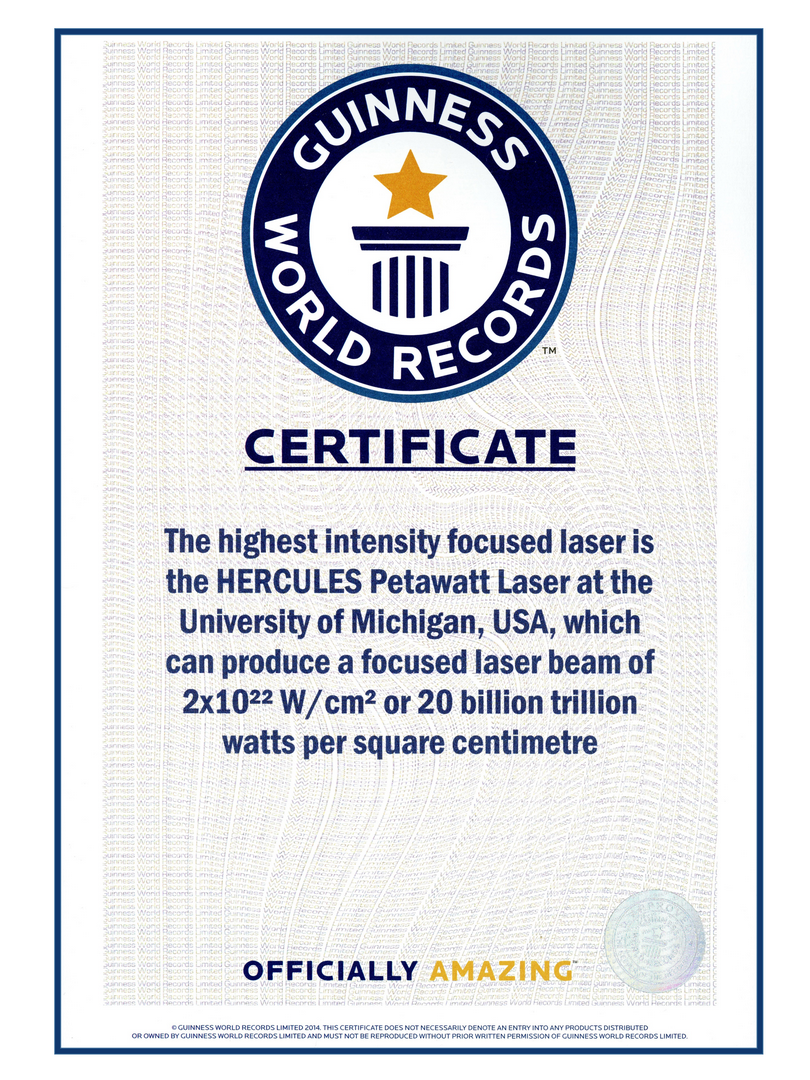
Gérard Mourou Center for Ultrafast Optical Science (CUOS) is an interdisciplinary research center in the College of Engineering at the University of Michigan. CUOS was sponsored as a Science and Technology Center by the National Science Foundation during 1990-2001, and as a College of Engineering Center continues its research in ultrafast optics with funding from a variety of government agencies and industry. Its mission is to perform multidisciplinary research in the basic science and technological applications of ultrashort laser pulses, to educate students from a wide variety of backgrounds in the field, and to spur the development of new technologies. These ultrafast lasers enable a tremendous range of applications in fundamental science and applied technology; further information on these applications may be found on About CUOS page, and details of specific research programs may be found under Research Groups. CUOS houses a 500-terawatt HERCULES laser, which has held a Guinness world record of the highest focused intensity of 2×10²² W/cm2 for 10 consecutive years and is under expansion into the flagship high-intensity laser user facility in the United States, under the name ZEUS (Zettawatt-Equivalent Ultrashort pulse laser System). ZEUS will reach the peak power of 3 petawatts and is supported by the National Science Foundation.